

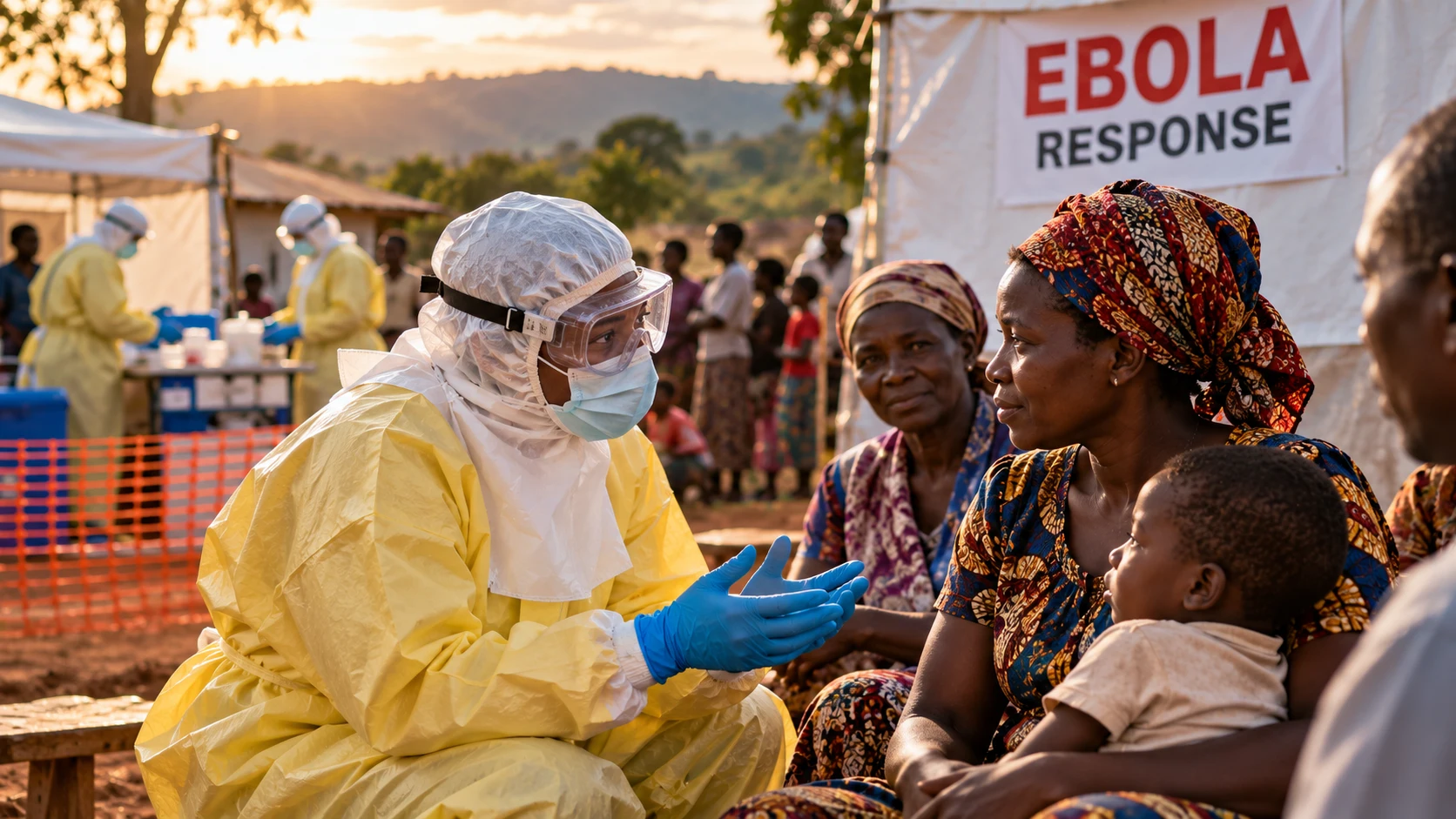
Why trust and community partnership are essential to ending Ebola outbreaks.
Ebola virus disease (EVD) is a severe viral hemorrhagic illness caused by infection with viruses of the Filoviridae family. Three viruses are known to cause major Ebola disease outbreaks: the Ebola virus, Sudan virus, and Bundibugyo virus. The average case fatality rate is around 50%, although it has ranged from 25% to 90% in previous outbreaks. Early intensive supportive care, including rehydration and symptom management, significantly improves survival. Effective outbreak control relies on a comprehensive package of interventions, including supportive patient care, infection prevention and control, disease surveillance and contact tracing, laboratory services, safe and dignified burials, vaccination where appropriate, and social mobilization.
To provide insight into what it takes to contain an Ebola outbreak on the ground, we heard from four remarkable panelists who have worked on the frontlines of outbreak response, surveillance, research, and community engagement. Throughout the discussion, one message emerged consistently: building trust and listening to communities are fundamental to an effective response.
Dr. Waly Diouf, social scientist and researcher, shared the powerful perspective that communities should be viewed as stakeholders rather than merely beneficiaries of interventions. Communities are not obstacles to outbreak response; they are essential partners. When communities are informed, engaged, and trusted, they become one of the strongest forces in controlling an outbreak.
African communities are deeply rooted in their cultures, and healthcare professionals and frontline workers have a responsibility to ensure that epidemiological protocols are implemented in ways that respect these cultural practices. While outbreaks are often approached through the lens of clinical and biomedical risk, they also involve profound social risks. Bridging these two dimensions is critical. Indigenous ways of knowing, grounded in listening, respect, and trust, are invaluable in strengthening outbreak response.
Dr. Benigna Namara, Epidemiologist and Public Health Specialist, reminded the audience not to lose sight of our humanity in the midst of an outbreak. During contact tracing and quarantine, affected individuals are sometimes treated as though they have done something wrong. There have been instances where quarantine measures were implemented without adequate preparation, undermining trust and ultimately affecting the effectiveness of the response.
Dr. Hannington Katumba, Veterinary Doctor and Epidemiologist, emphasized the importance of the Once Health approach, which recognizes the interconnectedness of animal, environmental, and human health. He emphasized that Ebola must be understood within its community context and addressed through multidisciplinary collaboration.
Learning from previous outbreaks remains essential to strengthening future preparedness and response.
Dr. Nella Ntumba, Global Health Expert, spoke about the diversity within communities and the importance of tailoring response strategies accordingly. Communities have distinct practices, traditions, and social structures. In many cases, people place greater trust in their village chief or local administrative leader than in external responders. Engaging these trusted local leaders is therefore essential for communicating public health information and fostering community confidence. Dr. Waly added that some of the most influential grassroots leaders may hold no formal political or administrative position, yet they command immense trust within their communities and can play a pivotal role in connecting response teams with local populations.
When asked what single message they hoped the audience would take away, all four panelists reiterated the importance of treating communities as stakeholders and genuine partners in the response framework. Dr. Diouf emphasized that communities possess their own knowledge systems and social strengths, making it essential to listen to and learn from them. Dr. Namara stressed that Ebola, like any other infectious disease, must be approached with respect and dignity rather than fear or criminalization. Ebola does not discriminate. While it was once widely believed to disproportionately affect poorer and more marginalized populations, the current outbreak has also affected many affluent individuals — a thought-provoking reminder that infectious diseases transcend social and economic boundaries. Dr. Ntumba highlighted that the Ebola response is a global responsibility, with each of us having a role to play. Dr. Katumba concluded by reinforcing the need for a multidisciplinary approach, noting that Ebola is simultaneously an animal, environmental, human, and community disease. Learning from previous outbreaks remains essential to improving future responses.
The discussion was rich with knowledge, lived experience, and practical insights. Above all, it served as a reminder that successful outbreak response is not driven by science alone. When we approach public health challenges with both our minds and our hearts — grounded in empathy, trust, and genuine partnership with communities — we create responses that are not only more effective, but also more humane.
Keep an eye out for the next episode of this series wherein the panelists give their expert opinions about how the Ebola outbreak response was implemented in the Democratic Republic of the Congo (DRC) and Uganda.
References
Hasan, S., Ahmad, S. A., Masood, R., & Saeed, S. (2019). Ebola virus: A global public health menace: A narrative review. Journal of Family Medicine and Primary Care, 8(7), 2189–2201. https://doi.org/10.4103/jfmpc.jfmpc_297_19
World Health Organization. (2025). Ebola disease. https://www.who.int/news-room/fact-sheets/detail/ebola-disease
ABOUT THE GUESTS
Dr. Benigna Namara, MBChB, MPH, MMed, PGDME
Dr. Namara is a public health and infectious disease specialist with expertise in epidemiology, disease surveillance, and outbreak response. She led the surveillance arm in the Rwenzori Region during Uganda’s 2025 Sudan Ebola Virus outbreak and has supported public health initiatives focused on disease prevention, vaccination, and health policy.
Dr. Waly Diouf, MPH, PhD
Dr. Diouf is a social science researcher specializing in the socio-anthropology of health, governance, and public policy. His work focuses on community engagement, risk communication, and epidemic management, including Ebola and COVID-19, with research experience in Senegal and Guinea. He also has expertise in maternal and child health, health research, and developing culturally informed approaches to public health.
Dr. Hannington Katumba, BVM, MSc, FETP
Dr. Katumba is an epidemiologist specializing in disease surveillance and One Health, with experience responding to outbreaks including Ebola, Marburg, Rift Valley Fever, Mpox, and Anthrax. His work spans government health systems and public health programs across Uganda, Kenya, Malawi, and Ghana, with a focus on strengthening surveillance, outbreak preparedness, and resilient communities.
Dr. Nella Ntumba, MD, MPH
Dr. Ntumba is a global health and infectious disease specialist with expertise in epidemiology and outbreak response. She supported Ebola response efforts in the Democratic Republic of Congo, contributing to research, community engagement, and surveillance. She has also worked in COVID-19 health program evaluation, focusing on data analysis and improving healthcare delivery.